
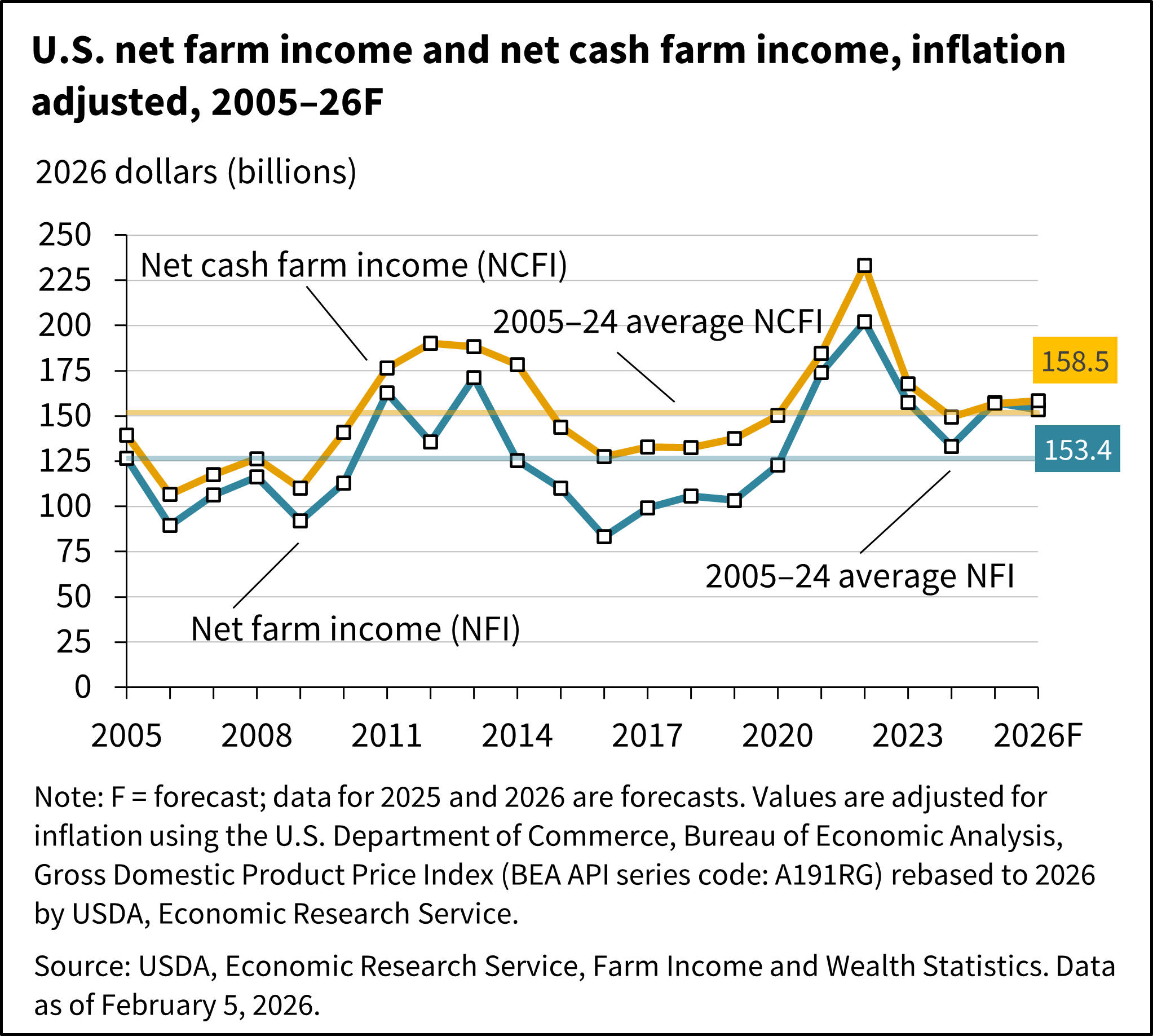
The United States farm sector is bracing for a slight decline in income for the 2026 calendar year. According to the latest forecast, net farm income, a broad measure of profits, is expected to drop by $1.2 billion, or 0.7 percent, compared to 2025. This development comes as the agricultural industry continues to navigate the complexities of the global market. With a forecasted net farm income of $153.4 billion for the year, farmers and industry experts are closely watching the situation to see how it will impact the sector’s overall finances.
Farm Income Forecast Slips Amid Market Uncertainty
Farm income forecasters are warning of a decline in farm sector income amid market uncertainty. The forecast for net farm income, a broad measure of profits, is expected to dip slightly in 2026. At $153.4 billion for the calendar year, net farm income would be $1.2 billion lower than in 2025, representing a 0.7 percent decrease.
| Aspect | Details |
|---|---|
| Event | Net farm income forecast to decline slightly |
| Date | 2026 |
| Location | United States |
| Key People/Organizations involved | Economic Research Service |
| Status/Current Situation | Forecast |
| Impact/Casualties | $1.2 billion lower than in 2025 |
| Net farm income forecast | $153.4 billion |
| Net cash farm income forecast | $158.5 billion |
| Year-over-year change in net farm income | -0.7% |
| Year-over-year change in net cash farm income | 3% |
| Farm cash receipts forecast | $514.7 billion |
The decline in net farm income is attributed to a forecast decrease in farm cash receipts, which are expected to drop by $14.2 billion (2.7 percent) from 2025 to $514.7 billion in 2026 in nominal dollars. However, total crop receipts are forecast to increase by $2.8 billion (1.2 percent) from 2025 levels to $240.8 billion in 2026, driven by higher receipts for corn. Net cash farm income, on the other hand, is forecast to increase by $4.6 billion (3 percent) relative to 2025, reaching $158.5 billion in 2026. This growth is largely due to the increase in crop receipts.
While the decline in farm income may seem concerning, it’s worth noting that both net farm income and net cash farm income are forecast to remain above their 2005-24 averages in inflation-adjusted dollars. This suggests that the farm sector is still experiencing growth, albeit at a slower pace. As the market continues to evolve, farmers and policymakers will be closely watching the developments in the farm sector to gauge the impact of these changes on the industry.
Market Impact of Declining Farm Income

The decline in farm income is expected to have a significant market impact, with net farm income forecast to decline by $1.2 billion (0.7 percent) in 2026 compared to the previous year. This decrease is attributed to a $14.2 billion (2.7 percent) drop in farm cash receipts from 2025 to 2026. Despite this, net cash farm income is forecast to increase by $4.6 billion (3 percent) relative to 2025, indicating a slight improvement in the farm sector’s financial situation.
The decrease in farm cash receipts is a result of a decline in total farm cash receipts, which are forecast to reach $514.7 billion in 2026, a $14.2 billion (2.7 percent) drop from 2025 levels. This decline is expected to have a ripple effect on the agricultural economy, potentially impacting the livelihoods of farmers and rural communities. However, the forecast also suggests that net cash farm income will remain above its 2005-24 average in inflation-adjusted dollars.
The market impact of declining farm income will likely be felt across various sectors, including agriculture, food processing, and retail. As farmers struggle to maintain profitability, they may be forced to adapt their production strategies, potentially leading to changes in crop and livestock production. The long-term implications of this decline in farm income remain to be seen, but one thing is certain: the farm sector will need to navigate this challenging landscape to ensure its continued viability.
Expert Analysis of the Farm Income Forecast

The forecast for net farm income in 2026 is a slight decline from last year, with a predicted $153.4 billion in profits. This represents a $1.2 billion decrease, or 0.7 percent, compared to 2025. Despite this decline, net farm income would still be above its 2005-24 average in inflation-adjusted dollars.
Net cash farm income, on the other hand, is expected to increase by $4.6 billion, or 3 percent, to $158.5 billion in 2026. This growth is a result of higher cash receipts from various agricultural products. In inflation-adjusted dollars, net cash farm income is forecast to rise by $1.7 billion, or 1.1 percent, from 2025 to 2026.
The farm sector’s financial indicators are expected to remain stable, with both net farm income and net cash farm income outperforming their historical averages. This trend suggests a resilient agricultural economy, despite the slight decline in net farm income.
Government Response to the Farm Income Forecast
The government has acknowledged the decline in farm income forecast, with net farm income expected to drop by $1.2 billion (0.7 percent) from 2025 to 2026. This decrease is attributed to a forecasted decline in farm cash receipts, which are expected to decrease by $14.2 billion (2.7 percent) from 2025 to 2026. Despite this decline, the farm sector’s financial indicators are still expected to remain above their 2005-24 averages in inflation-adjusted dollars.
The government’s response to the farm income forecast highlights the need for support to the agricultural sector. With net cash farm income forecast to increase by $4.6 billion (3 percent) relative to 2025, the government may consider measures to mitigate the impact of the decline in farm cash receipts. The government’s focus on supporting the agricultural sector is crucial, given the sector’s contribution to the country’s economy.
The government’s response to the farm income forecast also underscores the importance of monitoring the agricultural economy. With the farm sector’s financial indicators expected to remain above their 2005-24 averages, the government may consider policies to promote sustainable agricultural practices and support farmers in adapting to market uncertainties.
Future Outlook for Farm Sector Income
Farm income is expected to decline slightly in 2026, with net farm income forecast at $153.4 billion for the calendar year. This represents a decrease of $1.2 billion (0.7 percent) compared to 2025. Despite this decline, net farm income would still be above its 2005-24 average in inflation-adjusted dollars. The drop in net farm income is largely attributed to a decrease in farm cash receipts, which are forecast to decline by $14.2 billion (2.7 percent) from 2025 to $514.7 billion in 2026.
On the other hand, net cash farm income is forecast to increase by $4.6 billion (3 percent) relative to 2025, reaching $158.5 billion in 2026. This indicates that while farm income is expected to decline, farmers are still expected to receive more cash income in 2026 compared to the previous year. In inflation-adjusted dollars, net cash farm income is forecast to increase by $1.7 billion (1.1 percent) compared to 2025.
The forecast highlights the complexities of the agricultural economy, where different indicators are moving in different directions. While net farm income is expected to decline, net cash farm income is expected to increase, indicating that farmers are still receiving more cash income despite the decline in net farm income.
Farmer Reactions to the Decline in Farm Income
Farmers are expressing concern over the decline in farm income, as forecasted by the latest economic research. The $1.2 billion decline in net farm income, a broad measure of profits, from $154.6 billion in 2025 to $153.4 billion in 2026, is a significant blow to the agricultural community. This decline is attributed to a 2.7 percent decrease in farm cash receipts, which are forecasted to reach $514.7 billion in 2026.
Farmers are worried about the impact of this decline on their livelihoods and the overall stability of the agricultural economy. Despite the forecasted decline, net cash farm income is expected to increase by $4.6 billion, reaching $158.5 billion in 2026. However, this increase is largely due to an increase in total crop receipts, which are forecasted to reach $240.8 billion in 2026, driven by higher receipts for corn.
The decline in farm income has sparked concerns about the long-term sustainability of the agricultural sector. Farmers are calling for support and relief measures to mitigate the effects of this decline. As the agricultural community navigates this challenging period, the government and policymakers will need to carefully consider the implications of this decline and develop strategies to support farmers and the agricultural economy.