The agricultural economy is bracing for a slight decline in farm sector income, according to a recent forecast. With a calendar year projection of $153.4 billion, net farm income is expected to drop by $1.2 billion (0.7 percent) compared to 2025. This forecast comes as the farm sector continues to navigate the complexities of the agricultural economy. The decline in net farm income is a notable shift in the sector’s finances, and experts will be closely watching the developments in the coming months.
Net Farm Income Forecast for 2026 Revealed
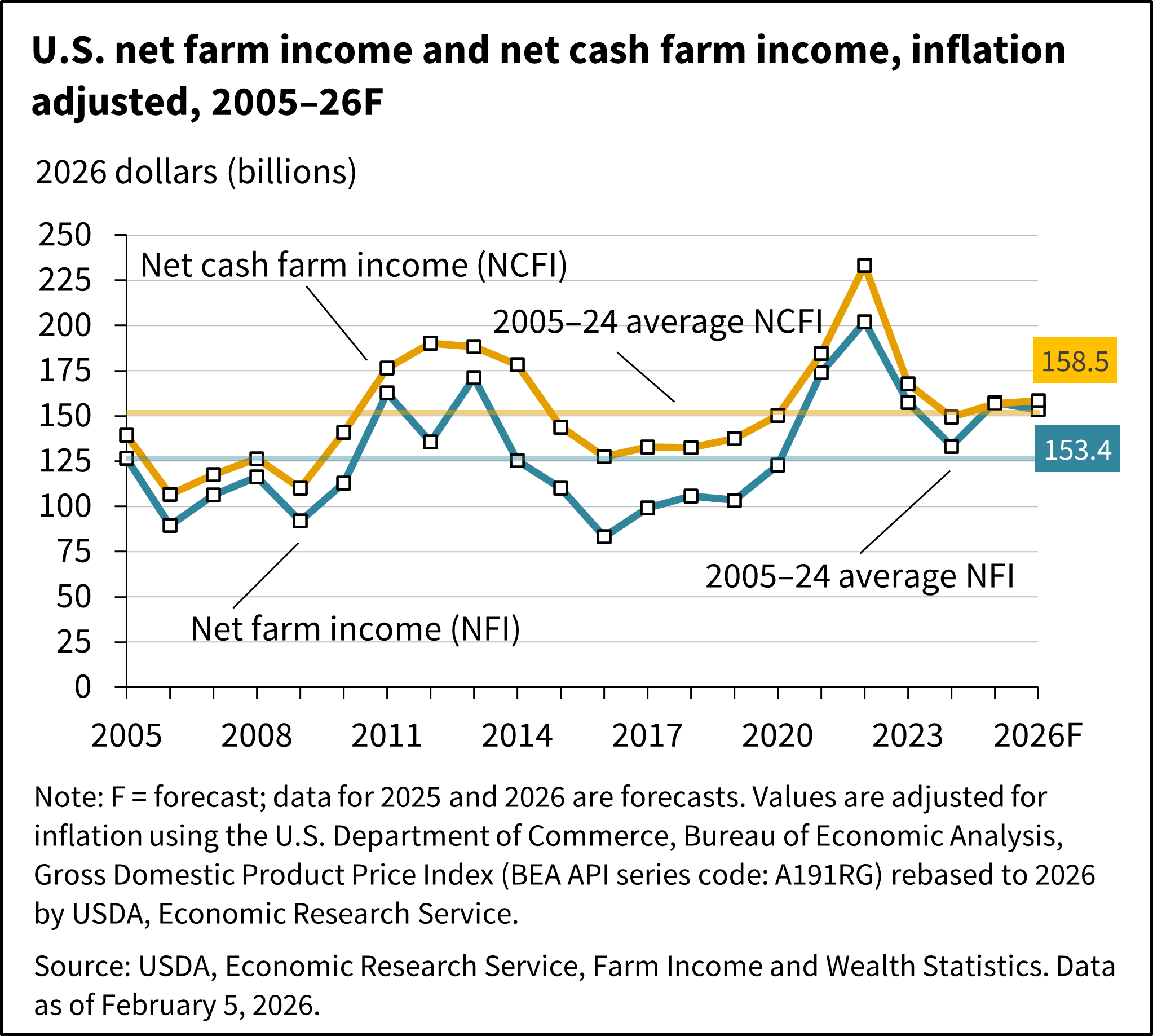
Net farm income, a broad measure of profits, is forecast to decline slightly in 2026. The forecast stands at $153.4 billion for the calendar year, representing a decrease of $1.2 billion (0.7 percent) compared to 2025. Despite this decline, net farm income would still be above its 2005-24 average in inflation-adjusted dollars.
| Aspect | Details |
|---|---|
| Event | Net farm income forecast to decline slightly |
| Date | 2026 |
| Location | United States |
| Key People/Organizations involved | Economic Research Service |
| Status/Current Situation | Forecast |
| Impact/Casualties | $1.2 billion (0.7 percent) lower than in 2025 |
| Net farm income forecast | $153.4 billion |
| Net cash farm income forecast | $158.5 billion |
| Year-over-year change in net farm income | -2.6 percent |
| Year-over-year change in net cash farm income | 1.1 percent |
In contrast, net cash farm income is forecast to increase by $4.6 billion (3 percent) to $158.5 billion in 2026, compared to 2025. This growth is significant, especially when considering that net cash farm income is a key indicator of a farm’s financial health. The increase in net cash farm income is a positive sign for the agricultural industry, as it suggests that farmers are managing their finances effectively.
The forecast for net farm income and net cash farm income is a crucial indicator of the farm sector’s financial health. Both measures are expected to be above their 2005-24 averages, indicating a relatively stable farm sector. However, the decline in net farm income is a reminder that the agricultural industry faces ongoing challenges, and farmers will need to adapt to changing market conditions to remain profitable. Net farm income is forecast to decline by $4.1 billion (2.6 percent) in inflation-adjusted dollars from 2025 to 2026.
Market Impact of Declining Farm Sector Income

Farm cash receipts are forecast to decrease by $14.2 billion (2.7 percent) from 2025 to $514.7 billion in 2026 in nominal dollars. This decline is a significant concern for the agricultural economy, as farm revenue is a crucial indicator of the industry’s overall health. The decrease in farm cash receipts is a result of various factors, including lower prices for certain commodities and a decline in global demand.
The total crop receipts are forecast to increase by $2.8 billion (1.2 percent) from 2025 levels to $240.8 billion in 2026, driven by higher receipts for corn. This increase is a welcome development for farmers and the agricultural industry, as it suggests that some sectors of the industry are performing well. However, the overall decline in farm cash receipts serves as a reminder of the challenges facing the agricultural economy.
The decline in farm cash receipts is likely to have a ripple effect throughout the agricultural industry, impacting farmers, suppliers, and other stakeholders. As the industry adapts to changing market conditions, it will be essential to monitor the situation closely and respond accordingly. The impact of the decline in farm cash receipts will be a key area of focus in the coming months, as the industry seeks to mitigate its effects and ensure long-term sustainability.
Expert Analysis of the Farm Sector Income Forecast

Farm sector finances are expected to undergo significant changes in the coming year. Net cash farm income is forecast to increase by $4.6 billion (3 percent) relative to 2025, reaching $158.5 billion in 2026. This growth is attributed to higher receipts for certain crops, such as corn. However, the overall farm cash receipts are forecast to decrease by $14.2 billion (2.7 percent) from 2025 to $514.7 billion in 2026.
The agricultural economy is expected to face a decline in net farm income, which is forecast to be $1.2 billion (0.7 percent) lower than in 2025, reaching $153.4 billion for the calendar year. Despite this decline, both measures in 2026 would be above their 2005–24 averages in inflation-adjusted dollars. This highlights the resilience of the farm sector despite the challenges it faces.
The farm sector’s financial indicators are expected to show a mixed picture in 2026. While net cash farm income is forecast to increase, farm cash receipts are expected to decline. This underscores the need for farmers and policymakers to closely monitor the sector’s financial performance and make informed decisions to mitigate any potential risks.
Government Response to the Farm Sector Income Forecast
The government has acknowledged the projected decline in farm sector income, with a focus on supporting farmers and the agricultural industry. The administration has pledged to work closely with farmers and agricultural stakeholders to mitigate the impact of the forecasted decline in farm cash receipts. Farm cash receipts are forecast to decrease by $14.2 billion (2.7 percent) from 2025 to $514.7 billion in 2026 in nominal dollars.
In response to the projected decline, the government has announced plans to increase funding for agricultural programs and initiatives aimed at supporting farmers and improving the overall health of the agricultural economy. Total crop receipts are forecast to increase by $2.8 billion (1.2 percent) from 2025 levels to $240.8 billion in 2026 following higher receipts for corn. This increase is seen as a positive development, and the government is working to build on this momentum by investing in programs that promote agricultural growth and development.
The government’s response to the farm sector income forecast reflects a commitment to supporting the agricultural industry and ensuring the long-term sustainability of farming operations. By working closely with farmers and agricultural stakeholders, the government aims to create a more stable and prosperous agricultural economy.
Future Outlook for the Farm Sector Income
The agricultural economy is expected to experience a slight decline in 2026, with farm cash receipts forecast to decrease by $14.2 billion (2.7 percent) from 2025 levels to $514.7 billion in nominal dollars. This decline is a result of lower crop receipts for certain commodities, despite higher receipts for corn. Total crop receipts are forecast to increase by $2.8 billion (1.2 percent) from 2025 levels to $240.8 billion in 2026.
Farm Sector Finances Show Resilience
Despite the decline in farm cash receipts, the farm sector finances are expected to show resilience in 2026. Net cash farm income is forecast at $158.5 billion for 2026, an increase of $4.6 billion (3 percent) relative to 2025. This increase is a result of higher cash receipts from crop sales, which will help to offset the decline in farm cash receipts. The farm sector’s ability to adapt to changing market conditions and maintain profitability is a testament to its resilience and ability to withstand economic fluctuations.
Implications for Farmers and the Agricultural Industry
Farm cash receipts are forecast to decrease by $14.2 billion (2.7 percent) from 2025 to $514.7 billion in 2026 in nominal dollars. This decline in farm cash receipts will have significant implications for farmers and the agricultural industry, as it will affect their revenue and profitability. The decrease in farm cash receipts is a result of lower prices for some commodities, which will impact farmers’ income and ability to invest in their operations.
Farmers will need to adapt to these changing market conditions and find ways to maintain their profitability. This may involve diversifying their crops or livestock, improving efficiency, and reducing costs. Additionally, farmers may need to consider alternative revenue streams, such as value-added products or agritourism, to supplement their income. The agricultural industry will also need to respond to these changes, potentially through investments in new technologies or marketing strategies.
The forecasted decline in farm cash receipts highlights the importance of understanding the agricultural economy and the factors that influence it. By analyzing trends and market conditions, farmers and industry stakeholders can make informed decisions about their operations and investments. This knowledge will be crucial in helping the agricultural industry navigate the challenges and opportunities that lie ahead.