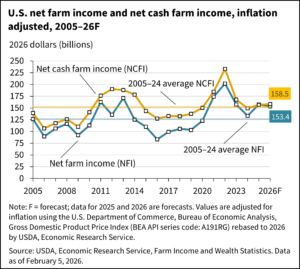

The agricultural industry is bracing for a slight decline in farm sector income in 2026, according to the latest forecast. A broad measure of profits, net farm income, is expected to dip by $1.2 billion, or 0.7 percent, from 2025 levels, reaching a total of $153.4 billion for the calendar year. This forecast comes as the farm sector continues to navigate the complexities of the agricultural economy, with the industry’s finances facing a mix of challenges and opportunities. As the sector adjusts to these changing circumstances, farmers and policymakers alike are keeping a close eye on the economic outlook for the year ahead.
Farm Sector Income Forecast Reveals Slight Decline
The farm sector income forecast for 2026 reveals a slight decline in net farm income. According to the forecast, net farm income is expected to reach $153.4 billion for the calendar year, which is $1.2 billion lower than in 2025. This decline represents a 0.7 percent decrease from the previous year.
| Aspect | Details |
|---|---|
| Event | Net farm income forecast to decline slightly |
| Date | 2026 |
| Location | United States |
| Key People/Organizations | Economic Research Service |
| Status/Current Situation | Forecast |
| Impact/Casualties | $1.2 billion (0.7 percent) lower than in 2025 |
| Forecasted Net Farm Income | $153.4 billion |
| Forecasted Net Cash Farm Income | $158.5 billion |
| Year-to-Year Change in Net Cash Farm Income | $4.6 billion (3 percent) |
| Year-to-Year Change in Net Farm Income (inflation-adjusted) | $4.1 billion (2.6 percent) |
Cash Farm Income to Increase
In contrast, net cash farm income is forecast to increase to $158.5 billion in 2026, marking a $4.6 billion or 3 percent increase from 2025 levels. When adjusted for inflation, net cash farm income is expected to grow by $1.7 billion or 1.1 percent compared to the previous year. Despite the decline in net farm income, both measures are forecast to remain above their 2005-24 averages in inflation-adjusted dollars.
Overall Farm Cash Receipts to Decrease
The farm sector income forecast also indicates that overall farm cash receipts are expected to decrease by $14.2 billion or 2.7 percent from 2025 to $514.7 billion in 2026. However, total crop receipts are forecast to increase by $2.8 billion or 1.2 percent from 2025 levels to $240.8 billion in 2026, driven by higher receipts for corn.
Market Impact of Declining Farm Income

The decline in farm income is expected to have a ripple effect on the broader agricultural industry. Net farm income, a broad measure of profits, is forecast to decline slightly in 2026, reaching $153.4 billion for the calendar year, a $1.2 billion decrease from 2025. This decline is expected to impact various sectors of the agricultural economy.
The decrease in farm income is also reflected in the forecast for farm cash receipts, which are expected to drop by $14.2 billion (2.7 percent) from 2025 to $514.7 billion in 2026 in nominal dollars. This decline is a significant concern for the agricultural industry, as it may lead to reduced investment and economic activity in rural areas.
Despite the decline in farm income, net cash farm income is forecast to increase by $4.6 billion (3 percent) relative to 2025, reaching $158.5 billion for 2026. This increase is a positive sign for the agricultural industry, indicating that farmers may be able to offset some of the losses through other revenue streams.
Expert Analysis on the Farm Sector Income Forecast

The farm sector income forecast for 2026 indicates a slight decline in net farm income, with a forecasted decrease of $1.2 billion (0.7 percent) compared to 2025. However, this decline is expected to be offset by an increase in net cash farm income, which is forecast to rise by $4.6 billion (3 percent) relative to 2025. This suggests that the agricultural industry outlook remains strong, with farmers adapting to changing market conditions and finding ways to maintain profitability.
Key Drivers of Farm Sector Finances
The farm sector finances are influenced by various factors, including crop receipts and cash receipts. In 2026, total crop receipts are forecast to increase by $2.8 billion (1.2 percent) from 2025 levels, driven by higher receipts for corn. Meanwhile, farm cash receipts are expected to decrease by $14.2 billion (2.7 percent) from 2025 to $514.7 billion in 2026. These trends highlight the complex dynamics at play in the agricultural industry, where fluctuations in crop prices and demand can have a significant impact on farm sector finances.
Long-term Trends in Farm Sector Income
Despite the slight decline in net farm income in 2026, the farm sector income forecast suggests that both net farm income and net cash farm income will remain above their 2005-24 averages in inflation-adjusted dollars. This indicates that the agricultural industry has been able to maintain its financial stability over the long term, despite short-term fluctuations in income. As the industry continues to evolve, it will be essential to monitor these trends and adjust strategies accordingly to ensure the long-term sustainability of farm sector finances.
Government Response to the Farm Income Forecast
The government has taken note of the farm income forecast, which projects a slight decline in net farm income for 2026. According to the forecast, net farm income is expected to reach $153.4 billion, a decrease of $1.2 billion or 0.7 percent from the previous year. This decline is a significant concern for the agricultural industry, which has been facing various challenges in recent years.
In response to the forecast, government officials have announced plans to provide additional support to farmers and rural communities. The government has committed to increasing funding for agricultural programs and initiatives aimed at improving farm productivity and resilience. This move is expected to help mitigate the impact of the decline in farm income and ensure the long-term sustainability of the agricultural sector.
The government’s response to the farm income forecast reflects its commitment to supporting the agricultural industry and ensuring the continued growth and development of rural communities. By providing additional funding and resources, the government aims to help farmers and rural communities adapt to the changing economic landscape and build a more resilient and sustainable agricultural sector.
Future Outlook for the Farm Sector
The agricultural industry outlook for 2026 is expected to be shaped by a decline in farm income. Despite this, both net farm income and net cash farm income are forecast to be above their 2005-24 averages when adjusted for inflation. Net farm income is projected to reach $153.4 billion, a decrease of $1.2 billion from 2025.
In contrast, net cash farm income is forecast to increase by $4.6 billion to $158.5 billion in 2026. This growth in net cash farm income is a positive sign for the agricultural economy. The farm sector’s financial indicators, such as farm cash receipts and total crop receipts, will also be influenced by this trend.
The overall financial health of the farm sector will be closely watched in 2026, particularly in light of the decline in farm income. Despite the challenges, the industry’s long-term prospects remain strong, with both net farm income and net cash farm income poised to exceed their historical averages. Farm cash receipts are forecast to decrease by $14.2 billion, while total crop receipts are expected to increase by $2.8 billion.