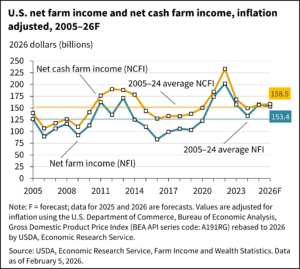

The US farm sector, a backbone of the country’s agricultural economy, is bracing for a slight decline in income in 2026. According to forecasters, net farm income, a broad measure of profits, is expected to drop by $1.2 billion (0.7 percent) compared to the previous year. This decline comes on the heels of a forecasted $153.4 billion in net farm income for the calendar year, a significant figure that underscores the importance of the farm sector to the nation’s economy. As the agricultural industry navigates the complexities of the market, farmers and policymakers alike will be keeping a close eye on these developments.
US Farm Sector Income Forecast for 2026 Released
The US farm sector income forecast for 2026 has been released, indicating a slight decline in net farm income. According to the forecast, net farm income is expected to reach $153.4 billion for the calendar year, a decrease of $1.2 billion (0.7 percent) from 2025. This decline is a result of lower farm cash receipts, which are forecast to decrease by $14.2 billion (2.7 percent) from 2025 to $514.7 billion in 2026.
| Aspect | Details |
|---|---|
| Event | Net farm income forecast to decline slightly |
| Date | 2026 |
| Location | United States |
| Key People/Organizations | Economic Research Service |
| Status/Current Situation | Forecast |
| Impact/Casualties | $1.2 billion (0.7 percent) lower than in 2025 |
| Forecasted Net Farm Income | $153.4 billion |
| Forecasted Net Cash Farm Income | $158.5 billion |
| Year-to-Year Change in Net Farm Income | -2.6 percent |
| Year-to-Year Change in Net Cash Farm Income | 1.1 percent |
Despite the decline in net farm income, net cash farm income is forecast to increase by $4.6 billion (3 percent) to $158.5 billion in 2026. This increase is a result of higher receipts for certain crops, such as corn, which are expected to contribute to an overall increase in total crop receipts. In fact, total crop receipts are forecast to increase by $2.8 billion (1.2 percent) to $240.8 billion in 2026.
The forecast also indicates that both net farm income and net cash farm income are expected to be above their 2005-24 averages in inflation-adjusted dollars. This suggests that the US farm sector is still experiencing growth, despite the slight decline in net farm income.
Market Impact of the Farm Sector Income Forecast

The decline in net farm income is expected to have a ripple effect on the agricultural economy, with potential impacts on farm finances and the overall farm sector outlook. Net farm income, a broad measure of profits, is forecast to decline slightly in 2026, reaching $153.4 billion for the calendar year. This represents a decrease of $1.2 billion (0.7 percent) from 2025 levels.
The decrease in net farm income is largely driven by a decline in farm cash receipts, which are forecast to decrease by $14.2 billion (2.7 percent) from 2025 to $514.7 billion in 2026. This decline is expected to have a significant impact on farm finances, with farmers potentially facing reduced revenue and increased financial pressure. However, it’s worth noting that net cash farm income is forecast to increase by $4.6 billion (3 percent) relative to 2025, suggesting that some farmers may be able to offset declines in net farm income through improved cash flows.
The farm sector income forecast also highlights the importance of crop receipts, which are forecast to increase by $2.8 billion (1.2 percent) from 2025 levels to $240.8 billion in 2026. This growth is largely driven by higher receipts for corn, which is a key crop for many farmers. Overall, the farm sector income forecast provides a complex picture of the agricultural economy, with both positive and negative trends influencing farm finances and the overall farm sector outlook.
Expert Analysis of the Farm Sector Income Forecast
The farm sector income forecast for 2026 paints a mixed picture, with net farm income expected to decline slightly from 2025 levels. According to the forecast, net farm income is projected to reach $153.4 billion for the calendar year, representing a $1.2 billion (0.7 percent) decrease from 2025. This decline is largely attributed to a decrease in farm cash receipts, which are forecast to drop by $14.2 billion (2.7 percent) from 2025 to $514.7 billion in 2026.
However, there are some positive trends to note. Net cash farm income is forecast to increase by $4.6 billion (3 percent) from 2025 to 2026, reaching $158.5 billion. This growth is largely driven by higher receipts for corn, which are expected to contribute to an increase in total crop receipts. In fact, total crop receipts are forecast to rise by $2.8 billion (1.2 percent) from 2025 levels to $240.8 billion in 2026.
Despite the decline in net farm income, the forecast suggests that both net farm income and net cash farm income will remain above their 2005-24 averages when adjusted for inflation. This indicates a resilient agricultural economy, with farmers adapting to changing market conditions and emerging trends. As the farm sector continues to evolve, it will be essential to monitor these trends and adjust strategies accordingly to ensure long-term sustainability and growth.
Government Response to the Farm Sector Income Forecast
The government has acknowledged the decline in farm sector income, with net farm income forecast to drop by $1.2 billion (0.7 percent) to $153.4 billion in 2026. This decrease is a slight deviation from the previous year’s trend, where net farm income was at its highest. The government is closely monitoring the situation to ensure that farmers are not disproportionately affected by the decline.
The government’s response to the farm sector income forecast has been to focus on supporting farmers through various initiatives. Net cash farm income is forecast to increase by $4.6 billion (3 percent) to $158.5 billion in 2026, providing a slight cushion against the decline in net farm income. This increase is a result of higher crop receipts, particularly for corn, which is expected to contribute to the overall growth in farm income.
The government’s strategy to address the decline in farm sector income is centered around providing support to farmers through various programs and initiatives. By focusing on initiatives that promote agricultural growth and stability, the government aims to mitigate the impact of the decline in net farm income and ensure that the farm sector remains a vital contributor to the country’s economy.
Future Outlook for the US Farm Sector
The US farm sector is facing a slight decline in net farm income for 2026, with a forecast of $153.4 billion. This represents a decrease of $1.2 billion, or 0.7 percent, compared to 2025. Despite this decline, net cash farm income is expected to increase by $4.6 billion, or 3 percent, to $158.5 billion in 2026.
The forecast also shows that farm cash receipts are expected to decrease by $14.2 billion, or 2.7 percent, from 2025 to $514.7 billion in 2026. However, total crop receipts are forecast to increase by $2.8 billion, or 1.2 percent, to $240.8 billion in 2026, driven by higher receipts for corn. Net farm income is forecast to be above its 2005-24 average in inflation-adjusted dollars.
The slight decline in net farm income is a result of various factors, including changes in market conditions and agricultural industry trends. Despite this, the farm sector is expected to remain resilient, with both net farm income and net cash farm income projected to be above their historical averages in 2026.